

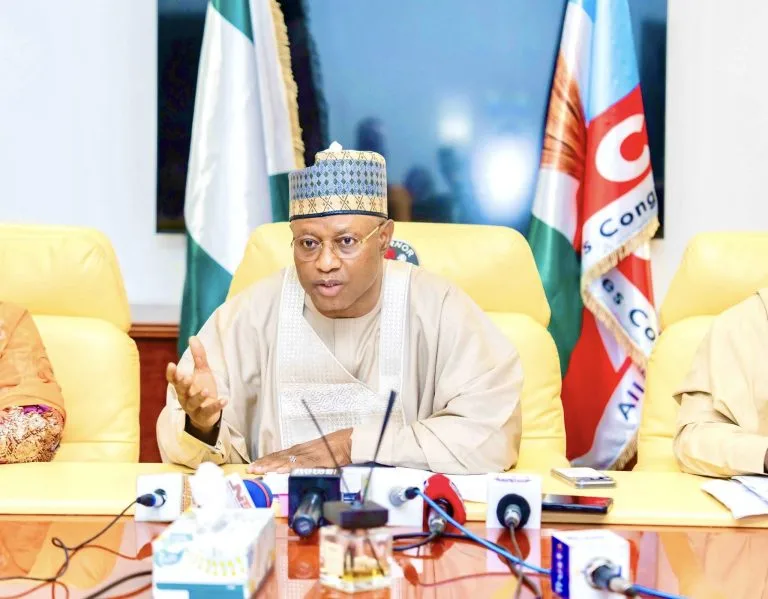
The Kaduna State governor, Senator Uba Sani, has described the documentation of the 217-year history of the Zazzaum Emirate as a significant contribution to historical scholarship and the preservation of cultural heritage.
The governor spoke in Zaria at the presentation of the book, which documents the lives, reigns and contributions of the 19 emirs who have occupied the Zazzau throne since 1808.
The event, held at the emir’s palace, was part of activities marking the sixth anniversary of the accession of the Emir of Zazzau, Mallam Ahmed Nuhu Bamalli to the throne.
Sani said preserving historical knowledge was essential to strengthening collective memory and enabling future generations to understand and engage meaningfully with their heritage.
“This publication enriches our historical scholarship and safeguards a heritage whose significance extends beyond the emirate,” he said.
Congratulating Bamalli on six years of what he described as dignified and purposeful leadership, the governor commended his commitment to peace, unity, cultural preservation and community development.
He reaffirmed his administration’s commitment to working closely with traditional institutions as key partners in reconciliation, social cohesion and inclusive development.
According to him, the emir’s reign has demonstrated the continuing relevance of traditional institutions in promoting social cohesion and fostering the trust and sense of belonging necessary for communal progress.
He also congratulated the scholars and historians whose efforts contributed to the production of the publication.
Speaking at the event, Emir Bamalli said the book was produced to address gaps in the historical documentation of the emirate and prevent the distortion or loss of its identity.
He noted that the last major documentation of Zazzau’s history was undertaken about 75 years ago, during which some historical facts had been lost while inaccuracies continued to circulate.
The emir said the new publication was intended to enable the emirate take ownership of its history, correct past inaccuracies and ensure that future generations inherited a credible account of their heritage.
“The people without documented history are at the risk of forgetting who they are. History is not merely about the past; it is about identity, continuity, lessons and legacy,” he said.
Bamalli said documenting the history of all the 19 emirs from 1808 to 2025 would strengthen the emirate’s heritage and provide a foundation for younger generations to understand their past.
He commended the authors, researchers, editors and other contributors, describing historical research as a task requiring patience, diligence, honesty and respect for facts.
The emir urged schools, universities, libraries, cultural institutions, researchers and the general public to read and critically study the publication and use it as a reference for future scholarship.
He also disclosed that the initiative was driven by the need to establish a stronger historical and cultural resource base within the emirate, including a library and museum, where young people, researchers and visitors could access materials of historical and cultural importance.
Reviewing the book, Dr Usman Bugaje described it as an important contribution to indigenous historical scholarship, noting that it drew on archival materials, about 127 interviews and extensive references.
Bugaje commended the authors for documenting Zazzau history from indigenous perspectives, thereby reducing reliance on colonial sources.

